
Estimated reading time:9 minutes
A sanctions compliance program is a risk-based system of governance, risk assessment, screening and other internal controls, escalation, reporting, recordkeeping, testing, and training designed to help an organization comply with the sanctions regimes applicable to its activities. Its scope should reflect the organization’s jurisdictions, customers, counterparties, products, services, transactions, delivery channels, and ownership exposure.
This guide explains how those elements work together, how sanctions controls interact with an organization’s broader financial crime compliance framework and anti-money laundering controls, and how organizations can test whether a program operates as intended. Legal obligations and transaction outcomes vary by jurisdiction, so organizations should verify the rules that apply to each activity.
Sanctions compliance is an important part of managing financial crime risk. Control failures can lead to regulatory scrutiny and legal, operational, or reputational consequences, depending on the applicable jurisdiction and conduct. Effective internal controls help financial institutions document decisions, demonstrate oversight, and respond consistently to sanctions risk.
Table of contents
- What Is a Sanctions Compliance Program?
- Key Takeaways
- How Do Sanctions Compliance and AML Differ?
- Types of Sanctions Regimes
- Obligations for Financial Institutions
- The Core Elements of a Sanctions Compliance Program
- Sanctions Risk Implications
- Common Challenges in Sanctions Compliance Program
- Sanctions Program Testing, Assurance, and Continuous Validation
What Is a Sanctions Compliance Program?
A sanctions compliance program translates applicable legal restrictions into operational controls. Depending on the organization and regimes involved, those controls may include screening, ownership and control analysis, match investigation, escalation, licensing, reporting, recordkeeping, training, testing, and accountable governance.
Sanctions compliance can apply across a financial institution’s customer lifecycle and transaction processes, including customer onboarding and due diligence, payments, trade finance, correspondent banking, securities, and custody. The program should consider both direct and indirect exposure to sanctioned or restricted parties and activity.
Key Takeaways
A sanctions compliance program begins with the regimes and exposure that apply to the organization, then translates them into governed controls. Screening is important, but effectiveness also depends on risk assessment, ownership analysis, escalation, reporting, records, training, testing, and accountable remediation.
- Identify applicable regimes and exposure before selecting controls.
- Treat screening as one component of the program, not the whole program.
- OFAC identifies five essential components for a US-focused program: management commitment, risk assessment, internal controls, testing and auditing, and training.
- Blocking, freezing, rejecting, declining, licensing, and reporting outcomes depend on the applicable jurisdiction and facts.
- Test data, list coverage, matching, ownership analysis, alert decisions, escalation, and issue remediation.
How Do Sanctions Compliance and AML Differ?
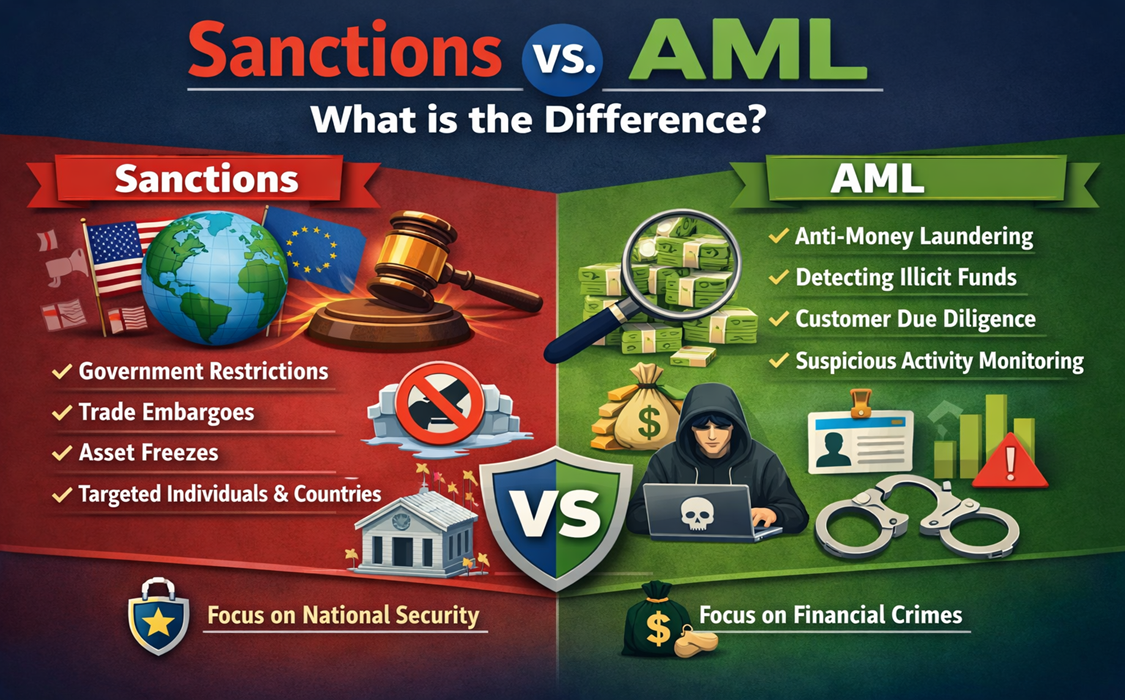
Sanctions compliance and anti-money laundering programs have different legal triggers and possible outcomes, but sanctions are not purely preventive and AML is not purely detective. A sanctions program determines whether applicable restrictions affect a party, activity, or transaction. An AML program assesses money-laundering and terrorist-financing risk, performs due diligence, uses AML transaction monitoring, investigates alerts, and reports suspicion where required.
Both programs may use preventive and detective controls, shared data, governance, escalation, recordkeeping, training, quality assurance, and testing. A sanctions result may require blocking or freezing, rejection, declining an activity, reporting, or seeking a licence or authorization. The correct outcome depends on the applicable law and facts; a name match alone is not a final legal determination.
Types of Sanctions Regimes
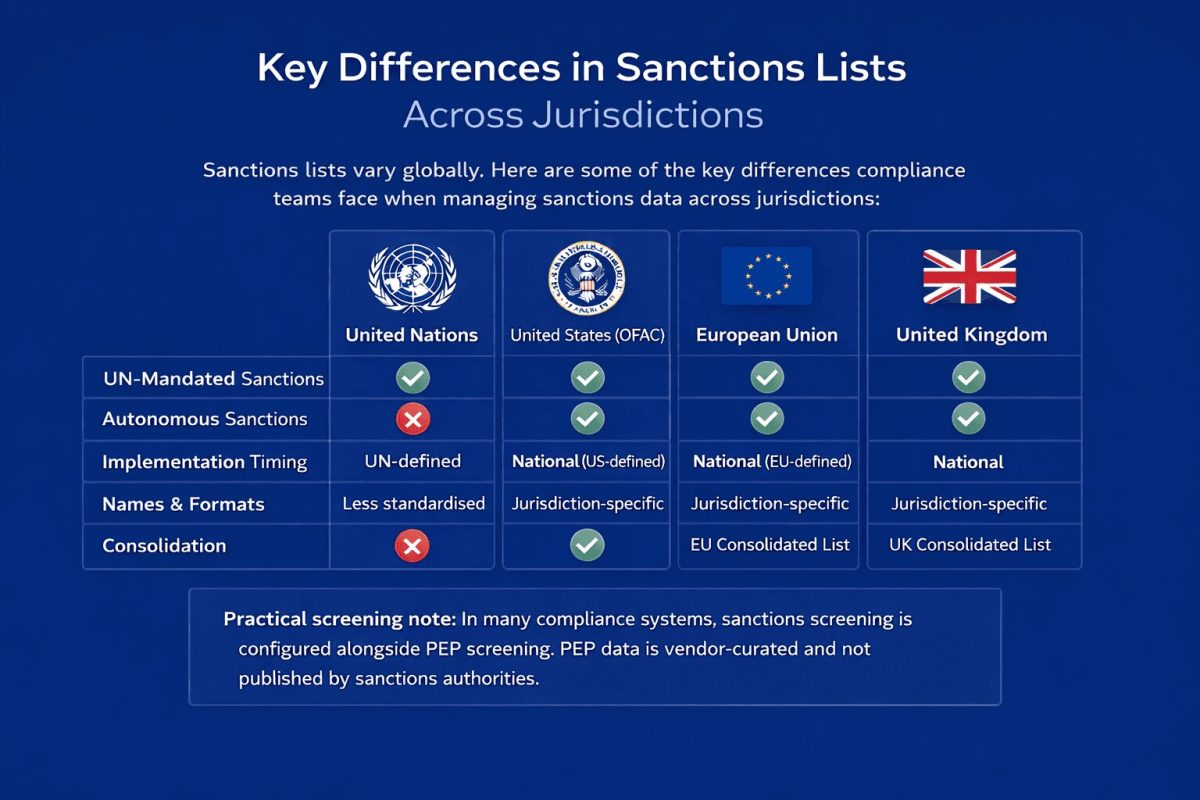
Institutions operating in multiple regions face complex regulatory requirements. These usually fall into several categories. Some rules apply widely across whole jurisdictions or geographic areas. Others focus on specific individuals, entities, or groups. There are also restrictions aimed at particular industries, that limit certain types of financial or commercial activities within those sectors. Additionally, some regulations extend beyond borders, imposing requirements on foreign institutions if they take part in prohibited transactions.
International organizations may need to assess overlapping UN, US, EU, UK, and other national regimes. The applicable lists, prohibitions, ownership and control tests, licensing routes, reporting duties, and enforcement standards must be confirmed for each relevant jurisdiction. See FCL’s guide to global sanctions regimes for the authority comparison.
Obligations for Financial Institutions
Applicable obligations depend on the relevant jurisdiction, organization, and activity. A sanctions program may need to identify applicable regimes, screen relevant parties and transactions, investigate potential matches, analyze ownership and control, document escalation decisions, take the required transaction action, manage licences or exceptions, submit reports, and retain records. Blocking, freezing, rejecting, declining, licensing, and reporting outcomes are not identical across all regimes.
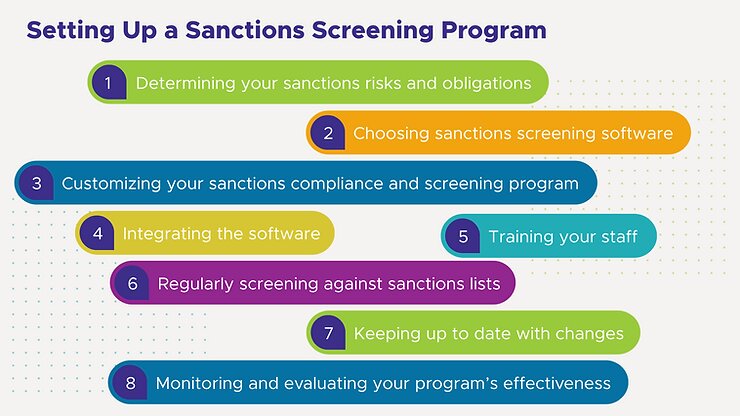
The Core Elements of a Sanctions Compliance Program
For organizations with relevant US exposure, OFAC’s Framework for Compliance Commitments identifies five essential components: management commitment, risk assessment, internal controls, testing and auditing, and training. This is a US framework and should not be presented as universal law.
Governance and Accountability
Effective sanctions governance requires clear roles, reporting lines, escalation authority, substantive senior-management oversight, and sufficient independence and authority for the sanctions compliance function.
Sanctions failures may arise from unclear accountability or escalation arrangements even where written policies exist. Roles, decision rights, oversight, and issue ownership should therefore be documented and tested.
Screening and Interdiction Controls
Screening is the operational process through which sanctions interdiction is achieved. Screening occurs as an institution checks its customers, counterparties, or payments against the appropriate sanctions lists to ensure that there are no matches before the transaction or the relationship is established.
These frameworks should be able to:
- Update the restricted party lists quickly.
- Handle complex data types such as names and non-Latin scripts.
- Balance accuracy with the risk of overwhelming the workload.
Screening controls should identify and route potential matches early enough for the organization to take the action required by the applicable regime. A confirmed result may require blocking or freezing, rejection, declining an activity, reporting, or a licensing decision; the required response varies by jurisdiction and facts.
Escalation and Reporting
Clear procedures for escalating alerts ensure they are reviewed based on their risk and complexity. When required by law, firms must report blocked or rejected transactions within specific timeframes. Even if the initial screening is effective, errors in the alert escalation and case management, such as late reporting or inconsistent handling, can lead to regulatory action.
Sanctions Risk Implications
Legal and Regulatory Consequences
Sanctions failures can lead to civil or criminal enforcement, remediation requirements, business restrictions, operational disruption, and reputational harm, depending on the jurisdiction and conduct involved. Any penalty amount, liability standard, or individual-accountability claim should be tied to the relevant law or a dated official enforcement notice.
Reputational and Operational Risks
In addition to this, there are financial implications, as well as a loss of confidence. Furthermore, there are implications for the banks involved, as they may try to distance themselves from a regulatory failure. To address this, there is a need for significant technical investment, as well as manual labor, which can be a drain on resources. The damage to reputation is also a major concern, as this is tied to issues of national security.
Common Challenges in Sanctions Compliance Program
Screening Limitations
Screening processes often encounter problems from low-quality data, reliance on matching only names, and challenges in tracking complex ownership and control structures. Tuning that reduces alert volumes without documented testing can increase false-negative risk and leave relevant name, alias, script, ownership, or payment-chain scenarios undetected. These problems are often made worse by outdated technology and broken screening systems, especially when handling complex, multi-step payment chains.
Governance and Oversight Gaps
Governance weaknesses can include unclear accountability, insufficient independent challenge, and slow issue resolution. Where an institution identifies a control gap, delayed remediation can prolong its exposure. A sanctions program works effectively only if its oversight structure allows for it. Without regular support from senior management and independent checks, technical controls weaken over time.
Emerging Expectations and Program Evolution
Expectations are also changing with the changing geopolitical environment. Institutions are expected to quickly implement new sanctions measures, carry out risk assessments on a number of scenarios, and integrate sanctions programs with other financial crime controls. Many financial institutions are looking for a sanctions compliance program sample to speed up the process. However, it is emphasized that the final goal is to be able to design a sanction compliance program that meets the specific risk profile of a financial institution. Even if generic models are available to provide structural solutions, they are often not designed to consider the special intricacies of each institution.
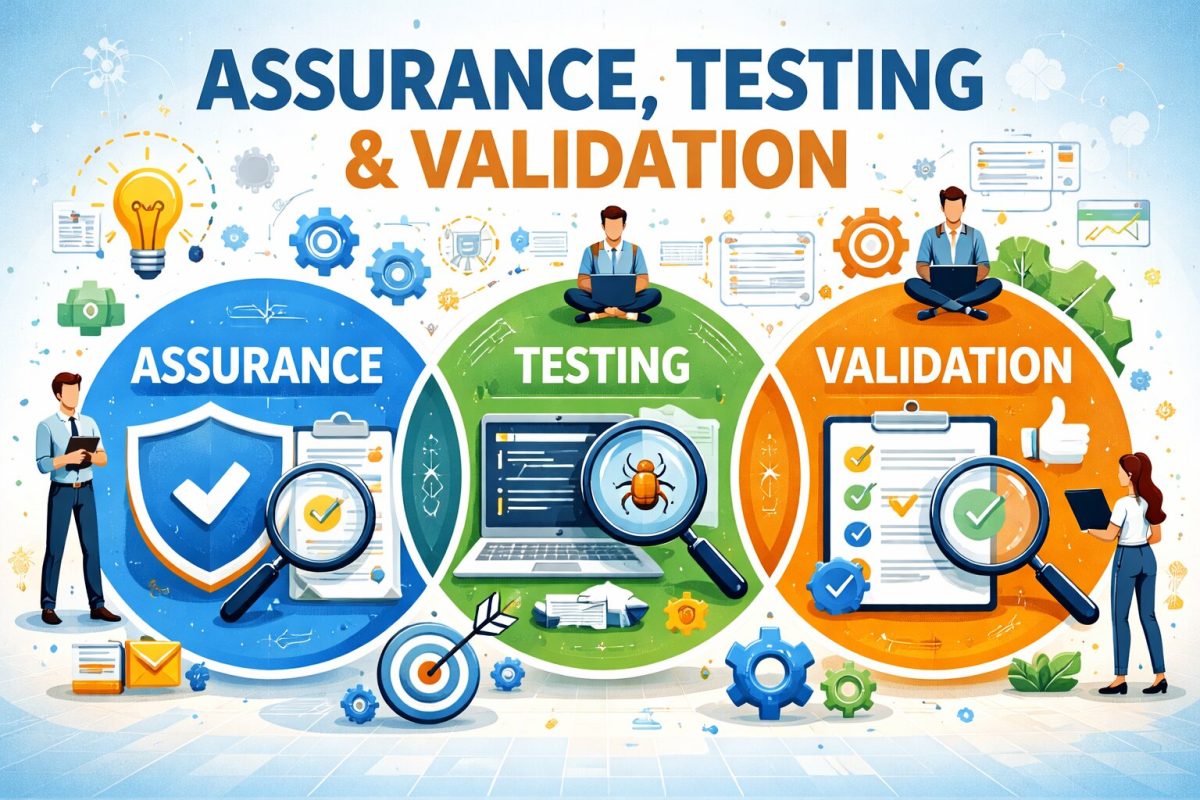
Sanctions Program Testing, Assurance, and Continuous Validation
A risk-based sanctions compliance program cannot rely on policies and system design alone. Testing should assess whether controls are appropriately designed, implemented, and operating as intended for the organization’s actual exposure.
Testing may include ongoing quality assurance of alert decisions, screening-system testing, independent compliance testing or internal audit, and model validation where the relevant tool is governed as a model. The program should test both decision quality and false-negative risk, particularly after changes to data, lists, matching logic, thresholds, or workflows.
For effective oversight, there is a need to regularly test screening systems. Here, there is a need to assess if restricted lists are being uploaded correctly, if matching logic correctly identifies various name types and scripts, and if all relevant data fields are being screened. Testing should not be limited to simple name matching but should also consider complex scenarios, including indirect ownership, entities under control of restricted parties, and non-Latin names.
Independent testing or internal audit can assess whether governance and controls are designed and operating as intended, including whether issues are identified, owned, and remediated. Independent validation or external assessment may be appropriate where required by the organization’s risk, governance, technology, or applicable standards. Model-validation terminology should be used only where the relevant tool or component is governed as a model.
In addition to US requirements, regulatory guidance from the UK Office of Financial Sanctions Implementation (OFSI General Guidance) and the Financial Conduct Authority (FCA FCG 7) establishes that testing programs to improve integrity should be systematically strengthened and address key operational risks. Organizations should track identified weaknesses continuously to have a sense of visibility. There should be ownership of the issues, and certain teams or people should be held accountable for the results. There should be a realistic time frame for resolution, and it should match the planned resolution time.
A clear pattern shows in institutional failures. They often occur when organizations respond slowly to issues or when leadership oversight is missing. Institutions that handle risk effectively use testing in their daily operations instead of viewing it as a separate compliance task. The results of tests then help decide where to allocate resources and which areas of governance need focus.
Final Perspective
Managing global trade and financial restrictions involves balancing regulatory responsibilities, geopolitical risks, and everyday operations. For financial institutions, a solid sanctions compliance program is not just about avoiding penalties. This program is vital for keeping regulatory credibility, improving operational strength, and fostering the professional trust needed to operate successfully in the global market.