


Estimated reading time:10 minutes
The financial crime landscape is evolving rapidly and criminals continue to adapt their strategies to exploit vulnerabilities within financial systems. For organizations in the Banking, Financial Services, and Insurance (BFSI) sectors, this highlights the critical need for effective KYC onboarding processes. Verifying customer identities and evaluating risks are crucial steps before onboarding any customer. Additionally, having a well-structured onboarding framework establishes a solid basis for ensuring compliance framework adherence and managing risks effectively.
This guide will examine the practical and regulatory dimensions of customer onboarding. The focus is on the importance of regulatory frameworks in guiding effective compliance choices. These frameworks help reduce the risk of financial crimes and support the ability to scale operations in an expanding digital environment.
Key Takeaways
- First Line of Defense: KYC onboarding is the foundational step in the AML compliance lifecycle.
- Risk-Based Approach (RBA): Not all customers require the same level of scrutiny. Apply Simplified, Standard, or Enhanced Due Diligence based on risk tier.
- Regulatory Navigations: Global standards from FATF provide the benchmark, but local laws (e.g., EU’s AMLDs, US’s BSA) dictate specific execution.
- Digital Expansion: Digital and remote onboarding introduces efficiency but requires strong fraud checks like liveness detection and biometric validation.
Table of contents
- Key Takeaways
- Introduction to KYC Onboarding
- Role of Customer Onboarding in the AML Lifecycle
- Core Components of KYC Onboarding
- Regulatory Foundations of KYC Onboarding
- Risk-Based Approach to Customer Onboarding
- Jurisdictional Differences in Onboarding Obligations
- Core Objectives of Customer Onboarding KYC
- The KYC Onboarding Process Explained
- Creating a Defensible Audit Trail
- Key Data and Documentation in Client Onboarding KYC
- Risk Considerations in KYC Onboarding
- KYC Onboarding for Different Customer Types
- Digital and Remote Customer Onboarding Models
- Technology and Systems Supporting KYC Onboarding
- Operational Challenges in Customer Onboarding
- Governance and Oversight of KYC Onboarding
- Best Practices for Effective KYC Onboarding
- Conclusion
Introduction to KYC Onboarding
In the Anti-Money Laundering (AML) framework, the onboarding stage establishes the essential profile that serves as a foundation for ongoing monitoring, investigations, and reporting. If onboarding controls are weak or not applied consistently, they can introduce risks right from the start.
Definition and Scope
KYC (Know Your Customer) onboarding is the process financial institutions use to identify and verify customers before providing access to their services. It requires gathering trustworthy proof of identity and assessing potential risks linked to money laundering, financing of terrorism, or corruption.
Essentially, the onboarding process helps ensure that regulated entities build clear and compliant relationships from the outset, promoting transparency and security in financial dealings.
Role of Customer Onboarding in the AML Lifecycle
Customer onboarding serves as the first line of defense in AML compliance. Key components include:
- Identity Verification (CIP): Collection and validation of core identity attributes (name, date of birth, address, ID number).
- Risk Assessment and Profiling: Establishing a customer’s risk tier (low, medium, high) to guide monitoring intensity.
- Customer Due Diligence (CDD) & Enhanced Due Diligence (EDD): Involves gathering information to understand the nature of the business relationship. EDD is applied to high-risk clients (e.g., PEPs).
- Screening Against Sanctions and Watchlists: New customers are screened against global databases to confirm they are not subject to restrictions.
- Beneficial Ownership Identification (KYB): For corporate entities, identifying the Ultimate Beneficial Owners (UBOs) prevents the use of shell companies.
- Setting the Baseline for Monitoring: Information collected during onboarding provides the benchmark for identifying “normal” behavior.
Core Components of KYC Onboarding
The rise of online banking has made the implementation of strong KYC onboarding procedures crucial for financial institutions (FIs). Four core components typically define onboarding frameworks:
- Customer Acceptance Policy (CAP)
- Customer Identification Program (CIP)
- Customer Due Diligence (CDD)
- Enhanced Due Diligence (EDD)
Regulatory Foundations of KYC Onboarding
Global standards for anti-money laundering enable organizations to implement a risk-based approach for onboarding customers.
Global KYC Regulatory Standards
These standards are largely based on the recommendations from the Financial Action Task Force (FATF), an organization which oversees the AML regime on a country level. FATF Guidelines establish international benchmarks for AML/CTF policies that nations adopt into local laws.
Regional Variations and Compliance
To achieve compliance, it is required to not only adhere to global principles but also navigate local regulations:
- EU: Governed by Anti-Money Laundering Directives (AMLDs).
- US: Guided by the Bank Secrecy Act (BSA) and the PATRIOT Act.
Institutions which operate internationally need to customize their onboarding processes to meet local requirements while still aligning with global standards.
Risk-Based Approach to Customer Onboarding
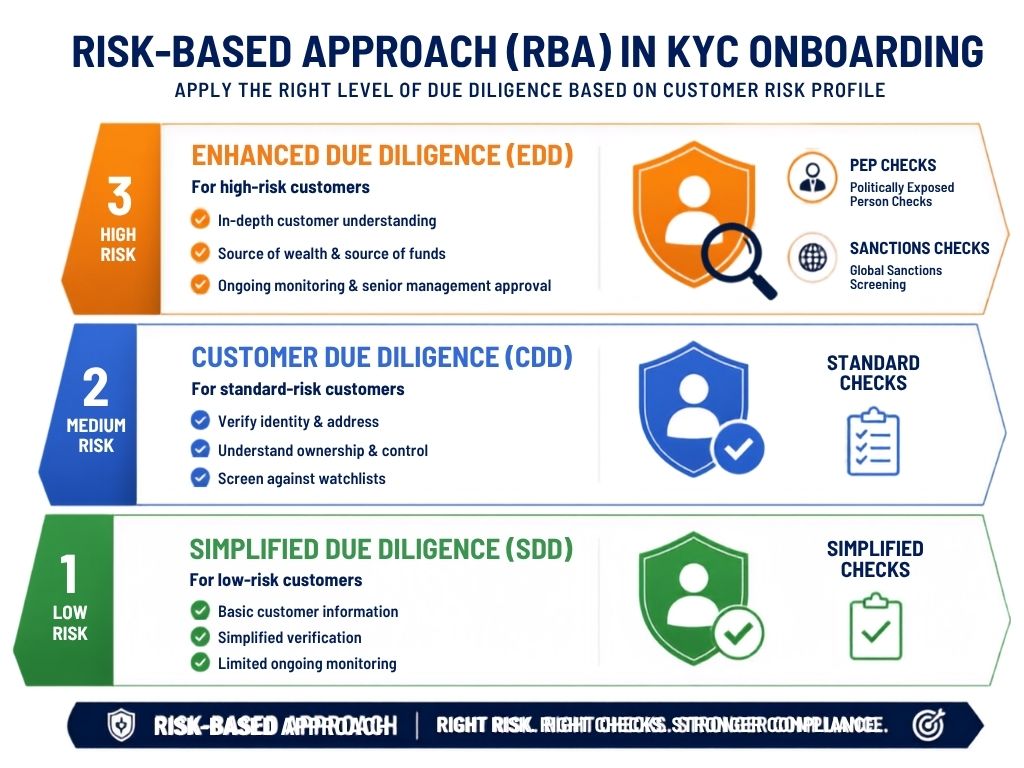
A risk-based approach (RBA) is a cornerstone of financial crime risk management that requires assigning risk ratings to the customer based on their individual profile. For example, customers assessed as low-risk can undergo simpler checks, while those deemed high-risk experience more thorough scrutiny.
Key Components of a Risk-Based Approach
- Risk Identification & Assessment: Customers are segmented into risk tiers based on factors such as geography, business type, and transaction volume.
- Tailored Due Diligence: Ranging from Simplified Due Diligence (SDD) for low risk to EDD for high risk.
- Continuous Monitoring: Risk profiles are updated continuously based on transaction behavior and adverse media.
Jurisdictional Differences in Onboarding Obligations
Differences in onboarding obligations and procedures stem from varying local AML laws, supervisory guidance, and enforcement practices across regions. In addition to global standards, each country has its own requirements regarding acceptable identification documents, verification methods, and thresholds for beneficial ownership.
Furthermore, the rules concerning non-face-to-face onboarding (e.g., digital onboarding), data retention, and regulatory access to records differ greatly among countries. Institutions operating internationally must customize their onboarding processes to meet local requirements while aligning with global standards. Relying on a standardized model without making necessary adjustments can lead to control gaps and supervisory findings.
Core Objectives of Customer Onboarding KYC
The main goals of customer KYC onboarding focus on creating a secure, compliant, and efficient relationship with new clients. These procedures are critical for identifying, verifying, and evaluating risks prior to initiating a business relationship.
The core objectives include:
- Regulatory Compliance and Legal Adherence
- Risk Mitigation and Security
- Operational Efficiency and Customer Experience
- Strategic Business Goals
Customer Identification and Identity Verification
Customer identification and identity verification are essential components of KYC and AML practices. These processes help identify customers, minimize fraud, and ensure adherence to regulatory standards. Identification includes gathering personal information (name, date of birth, address). Verification involves confirming this information through independent and reliable sources.
Verification Methods:
- Documentary: Passports, driver’s licenses, or national ID cards.
- Non-Documentary: Credit bureau checks, public records, and anti-fraud databases.
- Digital/Biometric: Facial recognition, liveness checks, and AI-driven document analysis.
Understanding Customer Purpose and Intended Business Relationship
Grasping the purpose of a customer and their intended business relationship (PBR) is a crucial element of Customer Due Diligence (CDD). This information clarifies a client’s decision to open an account and how they plan to utilize it, helping FIs establish a standard activity profile, evaluate risk levels, and identify unusual transactions.
Neglecting to accurately determine these details can result in violations of local and international regulations, including AML and CFT laws.
Establishing Baseline Customer Risk at Onboarding
Establishing a baseline for customer risk is a vital first step in ensuring AML compliance. This involves assessing the risk profile of potential customers based on identity, location, and expected behaviors.
- Customer Identification & Verification (CIP): Confirming identity using official documents and sometimes biometric verification or OTP.
- Geographic Risk: Assessing if the customer is located in or has ties to jurisdictions with weak AML regulations or high corruption.
- Customer/Business Type: Identifying high-risk profiles such as Politically Exposed Persons (PEPs), cash-intensive businesses, shell companies, or complex ownership structures.
- Expected Activity: Defining the expected volume, frequency, and nature of transactions.
- Screening: Checking against global sanction lists, PEP lists, and adverse media.
- Risk Scoring: Categorizing the customer as Low, Medium, or High risk.
The KYC Onboarding Process Explained
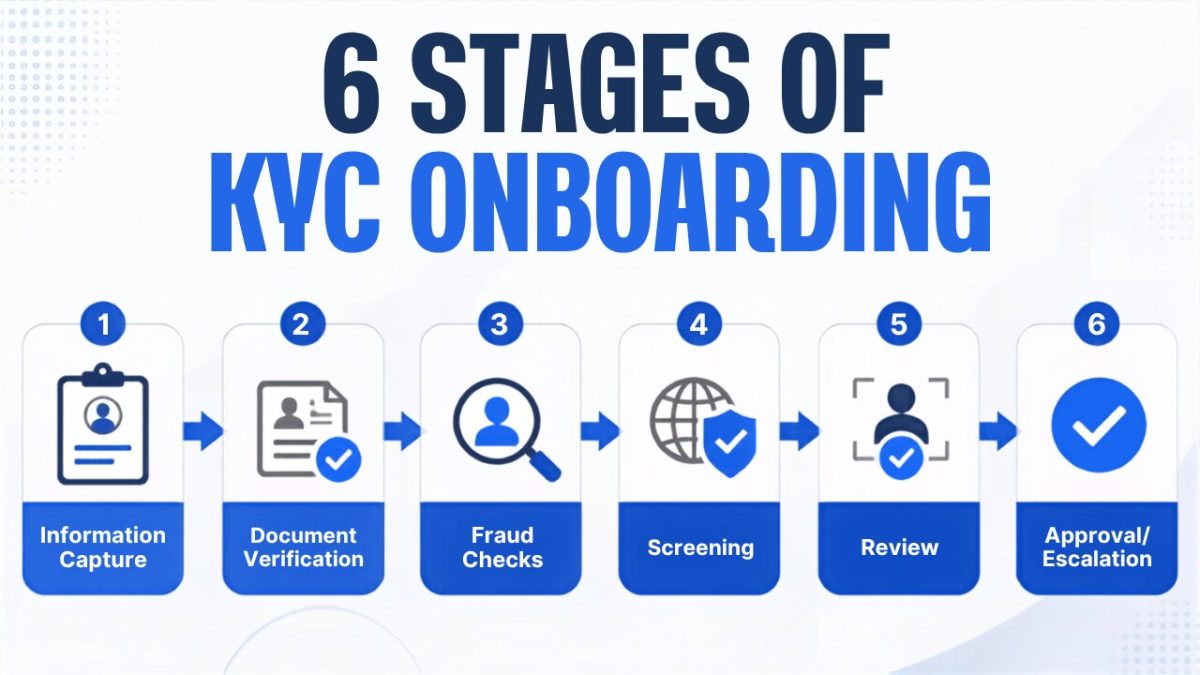
- Initiation and Information Capture: Systematically gathering data (name, DOB, address, nature of business).
- Document Processing and Validation: Examining and verifying ID and supporting documents.
- Identity Verification, Authentication, and Fraud Checks: Confirming that the customer is genuine.
- Sanctions, PEP, and Adverse Media Screening: Comparing customer info against relevant lists (e.g., WorldCheck).
- Risk Scoring and Segmentation: Categorizing customers by risk level to determine acceptance criteria.
- Approval, Rejection, or Escalation Workflows: Low-risk customers may be approved automatically, while higher-risk cases require escalation for senior review.
Creating a Defensible Audit Trail
An essential goal of KYC onboarding is to establish a robust audit trail that can withstand regulatory scrutiny. Regulatory bodies anticipate that organizations will provide clarity on the decision-making process during onboarding, disclose the information used, and detail how risks were evaluated.
Key Data and Documentation in Client Onboarding KYC
Customer onboarding requires the collection and verification of appropriate identification data and supporting documents based on customer type.
- Individual Customers: Personal identification information and valid identity documents.
- Entity Onboarding: Legal formation records, business registrations, and ownership structures. A critical component is identifying the Ultimate Beneficial Ownership (UBO) to establish transparency over individuals who ultimately own or control the entity.
FIs must also assess the source of funds and wealth to understand financial legitimacy. All data must be complete, accurate, and retained in line with regulatory expectations.
Risk Considerations in KYC Onboarding
Risk assessment during onboarding focuses on identifying customer risk factors at the outset of the relationship. These typically include customer type, business activity, and ownership characteristics, alongside geographic, product, and delivery channel risks.
Customers assessed as higher risk trigger enhanced due diligence (EDD) requirements, such as deeper verification and additional approvals. Institutions must also manage risks arising from an over-reliance on automation, as inadequate human oversight can result in the misclassification of risk and long-term exposure to financial crime.
KYC Onboarding for Different Customer Types
Onboarding requirements vary depending on the customer segment and associated risk profile:
- Retail and Individual Customers: Involves standardized identification and verification controls.
- Corporate and Legal Entities: Requires deeper assessment of ownership, UBO identification, control structures, and business activities.
- Non-Resident and Cross-Border Customers: Introduces additional risks related to jurisdictional differences and transparency challenges.
- PEPs and High-Risk Segments: Require enhanced scrutiny due to increased exposure to corruption and potential misuse of the financial system.
Digital and Remote Customer Onboarding Models
Digital onboarding is achieved by enabling remote, technology-driven identity verification rather than face-to-face interaction. Remote verification relies on electronic document submission, database checks, and automated validation.
Biometric, document, and liveness checks are used to confirm identity authenticity and reduce impersonation risk. However, non-face-to-face onboarding introduces specific risks, including identity fraud and technology limitations. Institutions must apply appropriate safeguards and oversight to ensure digital onboarding remains compliant and reliable.
Technology and Systems Supporting KYC Onboarding
Technology supports effective KYC onboarding through workflow automation that standardizes processes, brings efficiency, and increases accountability.
Integration with screening and risk engines enables real-time sanctions, PEP, and risk assessments during onboarding. Case management and escalation tooling support structured review and decision-making for higher-risk cases. Robust audit trails and regulatory evidence preservation ensure onboarding decisions can be reconstructed and defended during regulatory examinations.
Operational Challenges in Customer Onboarding
Operational challenges commonly stem from data quality issues and documentation gaps that undermine effective verification. Manual processing inefficiencies increase onboarding timelines and the likelihood of errors.
False positives and unnecessary escalations create friction for customers and compliance teams, leading to delays and resource strain. Institutions must balance regulatory compliance requirements with customer experience considerations, ensuring controls remain robust without creating avoidable barriers.
Governance and Oversight of KYC Onboarding
Strong governance is essential and is supported by clear policies, procedures, and onboarding standards. Defined roles and responsibilities across onboarding teams ensure accountability and consistent execution of controls.
Quality assurance and independent review functions assess adherence to onboarding requirements and identify control weaknesses. Regulatory examinations increasingly focus on audit readiness, requiring institutions to demonstrate that onboarding decisions are documented, traceable, and aligned with expectations.
Best Practices for Effective KYC Onboarding
Effective onboarding frameworks align controls with the institution’s defined risk appetite to ensure consistency between business strategy and compliance objectives.
It’s important to apply controls in a way that matches the level of risk involved. Customers who pose a higher risk should face more thorough checks, while those considered lower risk can be processed with simpler procedures. Regularly reviewing the onboarding process is crucial for adjusting controls based on regulatory changes and new financial crime risks.
Conclusion
Strengthening KYC onboarding frameworks is critical to maintaining effective AML compliance and managing financial crime risk. Strong onboarding controls support sound risk decisions, protect institutions from regulatory exposure, and enhance the reliability of downstream transaction monitoring. The landscape of financial crime risks is constantly changing, meaning the future of onboarding will depend on flexible, technology-driven structures.