


Source: ChatGPT
Table of contents
Let us be honest: In recent years, financial institutions and banks have encountered substantial regulatory penalties. It was quite surprising; although we frequently attribute these incidents to inadequate monitoring systems, However, the root cause lies in something else, such as deficiencies in our processes for reviewing, documenting, and managing potential financial crime risks. And in the days before robust AML case management, organizations were far more vulnerable to money laundering and financial crime risks.
Just think in a way that the AML case management as the central nervous system of your compliance program. It is the Accumulation of the control process that takes alerts and transforms them into controlled decisions. Nowadays, regulatory bodies are not just checking your findings, logic and patterns anymore; They are scrutinizing the entire case lifecycle. They want to see consistency, clear accountability, and the reasoning behind every key decision you make, along with how you are taking steps to mitigate that risk.
This guide takes you through how AML case management really works in practice. We will concentrate on the common defects we observe across the industry, as well as the structure and workflow that management expects.
What Is AML Case Management?
At its core, an AML case management system is your structured roadmap for supervising potential risk. It is the process you use to review, investigate, heighten, and formally close out possible money laundering or terrorist financing risks flagged by an alert or a referral.
It is basically sitting right in the middle between the initial risk identification and the final regulatory outcome. The core job is to turn those alerts into documented, risk-based decisions based on evidence and professional judgment.
The Role of Case Management in the AML Lifecycle
Source: Napki AI
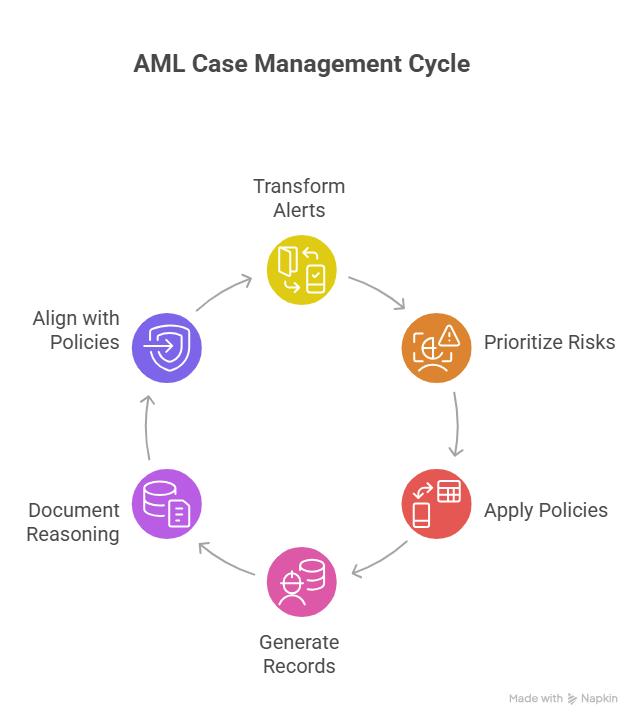
AML case management is typically accountable for a number of critical steps as part of the comprehensive AML lifecycle:
- It transforms alerts and referrals into structured analytical evaluations.
- It facilitates risk-based prioritization in line with financial crime risk exposure.
- It enables the uniform application of policies, typologies, and escalation procedures.
- It generates audit-ready records in line with regulatory requirements.
- It documents investigative reasoning and supporting evidence.
- It functions in line with current AML policies and typology structures.
Without an effective AML case management process, even sophisticated monitoring and detection systems can fail to meet regulatory requirements.
Alerts, Cases, and Investigations: Distinctions
The effective difference between alerts, cases, and investigations helps operational efficiency and effective risk management in AML case management:
- The alerts can be system-driven or manually initiated notifications of potentially unusual or suspicious activity.
- The cases are organized records initiated when an alert or referral requires formal review.
- The investigations are the systematic work performed within a case to determine the relevance of activity to financial crime risk.
Remember: It is very important to understand that not every alert becomes a case, and not every case ends in a Suspicious Activity Report (SAR). Your case management process controls these gates.
The Authoritative Sources of AML Cases
The AML cases can initiate from a variety of internal and external sources. A structured approach is intended to manage these points of entry with corresponding control and documentation.
Transaction Monitoring Alerts
Transaction monitoring is a key source of cases, including alerts driven by rules, thresholds, behavioral anomalies, or typology-based scenarios:
- Scenario-based rules
- Thresholds
- Behavioral anomalies
- Model-driven typologies
Risk-based triage is commonly used to deal with the number of alerts and to align the investigative effort with the underlying exposure.
Sanctions Screening Escalations
Sanctions screening escalation cases occur when the results of automated sanctions screening cannot be addressed without further review, such as:
- The Name or transaction matches above certain confidence levels
- The false positives that cannot be mechanically removed
- The complex ownership or control patterns detected
These kinds of cases typically involve collaboration between AML, compliance, sanctions, and legal teams.
Referrals and External Intelligence
The Cases may also be initiated through referrals and external intelligence, such as:
- The relationship manager referrals
- The employee concerns or whistleblowing
- The Law enforcement inquiries
- The regulatory requests or adverse media alerts
The referral cases typically require more in-depth contextual analysis and documentation.
AML Case Management Workflow
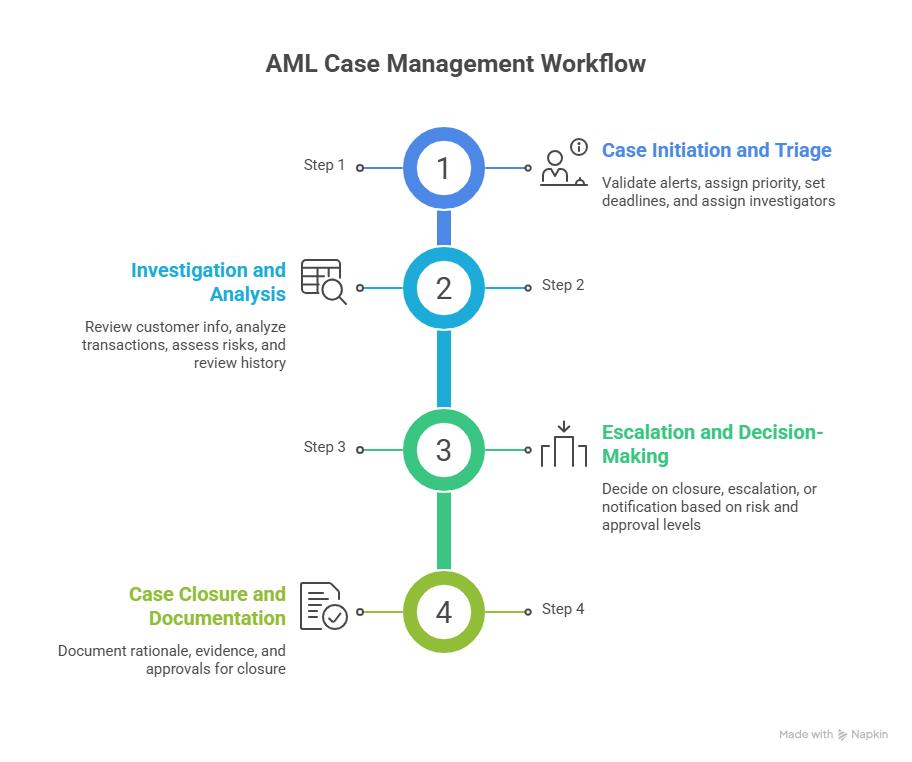
The standardized workflows allow consistent handling of cases across teams and geographies.
Source: Napkin AI
Step 1: Case Initiation and Triage
Case initiation typically involves validating the quality of alerts, assigning priority based on risk factors, establishing handling deadlines, and assigning cases to qualified investigators. Proper triage enables efficient handling of backlogged cases and enables timely escalation of higher-risk activity.
Step: 2 Investigation and Analysis
Investigation and analysis represent the changes to the essential steps of the AML case management system workflows. These activities typically include customer information review, transaction analysis, counterparty and geographic risk assessment, and historical activity review. Regulatory requirements stress the importance of evidence-based decision-making over checklist decision-making.
Step:3 Escalation and Decision-Making
Decision trees in AML case management may include:
- Closure as risk-irrelevant
- Closure as risk-relevant
- Escalation for deeper due diligence
- Escalation to senior compliance or legal staff
- Notification to concerned authorities
Decisions are expected to be based on established approval levels and documented reasoning.
Step 4: Case Closure and Documentation
Case closure usually involves the following:
- Rationale and closure comments
- Evidence and relevant references
- Verification of necessary approvals
Lack of documentation at the time of case closure is still a frequent supervisory finding.
Governance and Control Expectations
From a supervisory perspective, case management is an important tool for supervisors to maintain control over the investigative environment.
Policies and Procedures
The Policies and procedures describe how cases are created, investigated, escalated, reported, and archived. These documents are usually expected to adopt a sensible, consistent, and periodically updated approach.
Segregation of Duties and Control
So, what is the key difference in duties and controls? Let’s have a look. The control environments typically implement segregation between alert generation and case approval, as well as independent quality assurance review. The management review is typically implemented for higher-risk consequences to guarantee consistency and accountability.
Audit Trails and Recordkeeping
The Full audit trails and the recordkeeping facilitate regulatory reviews and internal audits. These records usually include time-stamped activity trails, versioning, and evidence management.
Modern AML Case Management Systems

Source: Unsplash.com
Although AML case management software systems may support these systems, regulatory emphasis is still on governance discipline and decision-making quality rather than technology.
Risk-Based Case Prioritization Models
Modern systems use dynamic risk-based scoring for cases, taking into account variables such as:
- Customer risk scores and changes to customer risk profiles
- Product, channel, and geographic risk exposure
- Deviation from behavioral patterns
- Association with higher-risk counterparties or networks
This enables the allocation of investigative effort in proportion to risk considerations.
Integrated Case Lifecycle Management
The up-to-date frameworks view cases as part of an overall lifespan process rather than as distinct events. Typical characteristics are:
- The up-to-date frameworks view cases as part of an overall lifespan process rather than as distinct events. Typical characteristics are:
- The access to previous alerts, cases, and results
- The integration of onboarding, monitoring, and investigation activities
- The consistency in reasoning for periodic and event-driven reviews
Judgment-Based Investigation Design
The regulators across different geographies tend to require human analysis that is informed by documented reasoning. The case management procedures are expected to include narrative conclusions, analyses based on hypotheses, and the judgment of analysts, in addition to results supplied by the system.
Embedded Quality Assurance and Feedback Loops
The quality assurance processes help ensure control effectiveness through targeted reviews, feedback to investigator training, and the use of review results to improve typologies and procedures.
Cross-Functional Escalation and Collaboration
The financial crime risks tend to involve more than one control function. The best practices help facilitate collaboration between AML, sanctions, compliance, legal, and fraud teams, with appreciation options to address accountability.
Regulatory Readiness by Design
The institutions are increasingly designing case management processes to facilitate supervisory reviews, internal audits, and regulatory exams on a regular basis.
Common Case Management Challenges
Even in more mature environments, there are operational challenges that Consistency and Quality Issues continue.
Alert Backlogs and Prioritization
High volumes of alerts could be a factor in delays, condensed reviews, and increased potential for errors. Risk-stratified prioritization and scenario tuning are typical methods of dealing with these challenges.
Consistency and Quality Issues
Irregularity in results could result from differences in analyst expertise, lack of planning in standards, or insufficient guidance. Also, can mislead in an action taken procedures and procedures. The quality assurance roles are crucial in ensuring consistency.
Additional Considerations for AML and Compliance Professionals
The technology is generally designed to enhance and provide efficient results, not replace human judgment. Overreliance on automation without sufficient governance could create control gaps.
The concerned metrics may go beyond volume metrics to include increased quality, rework rates, reporting quality, and case ageing by risk category.
Final Thoughts
The AML case management is the proving ground for your compliance program. You know complex detection scenarios are just the beginning; they won’t protect you on their own. It is the systematic analysis, the constant escalation procedures, and the careful and clear documentation that will keep regulators satisfied.
In order to really get around in the constantly changing financial crime and regulatory supervision landscape, businesses must establish their case management processes on the foundation of human knowledge, clearly defined accountability, and robust governance structures. It is imperative to regard this function as a critical control mechanism to preserve resilience.