

Estimated reading time:4 minutes
Key Takeaways
- KYC Services are crucial for regulatory compliance, covering customer identification, risk classification, and ongoing monitoring.
- KYC screening continuously checks customers against various databases to prevent financial crime exposure.
- Technology enhances compliance by automating processes and improving risk scoring, particularly for larger institutions.
- A risk-based approach is essential; high-risk customers require more scrutiny while low-risk customers benefit from streamlined processes.
- A robust compliance program is vital to safeguard against regulatory penalties and ensure precise documentation of customer risk assessments.
Table of contents
If you’ve ever sat in a compliance review wondering whether your team’s processes would truly hold up under regulatory scrutiny, you’re not alone. KYC Services are at the heart of every effective AML and financial crime compliance program and getting them right has honestly never been more important.
For banks, fintechs, DNFBPs, and other regulated institutions, this goes far beyond simply collecting a copy of an ID document. A well-built compliance framework properly identifies customers, assesses their individual risk profiles, and actively monitors those relationships throughout their lifecycles. As regulatory expectations continue to tighten globally, having a clear and integrated approach is no longer optional it is a baseline requirement that regulators will test. In this article, we are going to discuss the scope and importance of KYC as a service.
What Do KYC Services Cover?
At their core, KYC Services cover customer identification, legal verification, beneficial ownership analysis, risk classification, and ongoing monitoring. From the moment a customer engages with your institution, your team needs reliable, up-to-date information to confirm who they are, where they come from, and why they are doing business with you.
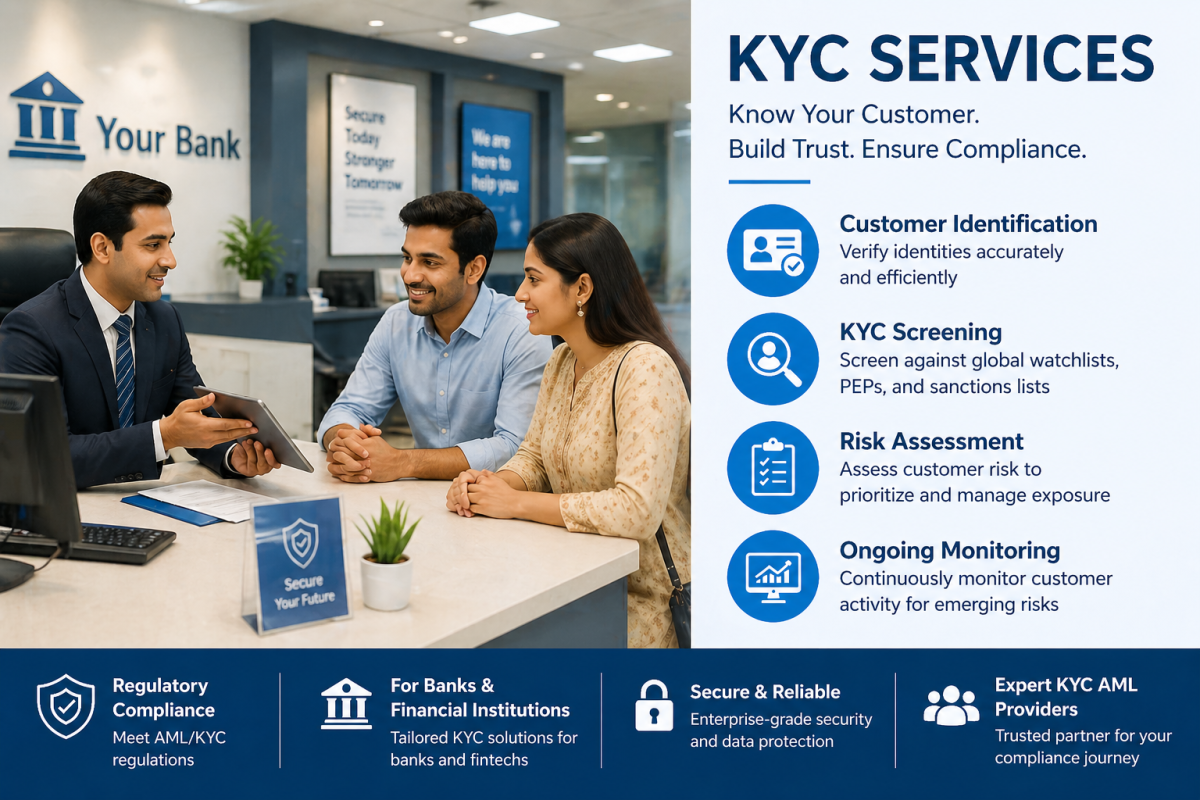
This is where KYC screening service becomes essential. Checking customers against sanctions lists, politically exposed person databases, and adverse media sources helps detect financial crime exposure before it becomes a serious liability for your institution. Importantly, KYC screening is not a one-time exercise at onboarding it must continue at regular, risk-appropriate intervals throughout the entire customer relationship to remain effective.
Technology and KYC Compliance Software
Manual systems just can’t cope with the current volumes of onboarding activity. Technology can assist an institution in managing processes efficiently, automating screening activities, and centralizing documentation, thereby greatly reducing the risk of inconsistent risk scoring, documentation issues, and the costly audits regulators are all too eager to launch.
For larger financial institutions, KYC software for banks needs to be scalable, flexible, and designed for the ever-changing regulatory landscape. It needs to incorporate risk-scoring models, screening alerts, and robust case management tools, while maintaining a complete audit trail of all decisions made along the way.
Know your client software takes this a step further by embedding a genuine risk-based approach directly into everyday compliance operations. The best-known client software captures key risk inputs, geography, customer type, product usage, and ownership complexity and transforms them into structured, defensible assessments. The goal is not just faster onboarding; it is smarter, more proportionate onboarding that can stand the test of time.
The Role of KYC AML Providers
In many instances, institutions may wish to outsource data feed providers, identity verification providers, or adverse media intelligence providers. While there are certainly benefits to this approach, it must be remembered that accountability for compliance rests squarely on the institution in question.
Risk-Based Approach and Ongoing Monitoring as KYC Services
It’s also important to understand that not all customers pose the same level of risk. It’s imperative to ensure that your compliance program accurately represents this. High-risk customers should be given extra scrutiny regarding due diligence, ownership, and periodic refresh cycles. On the other hand, low-risk customers should be able to go through a streamlined process as long as all the criteria are met. It’s also vital to ensure that changes to a customer’s sanctions risk, PEP risk, or adverse media are identified promptly so they’re not discovered too late, after the fact, so to speak.
Final Perspective
A robust compliance program remains an institution’s most effective line of defense, protecting it from regulatory censure, reputational damage, and material financial losses. Whatever the scale of investment or the sophistication of the controls deployed, the fundamental mandate is to ensure you do know your customer, assess the risk, and document the outcome with precision, consistency, and unwavering accountability. As the regulatory landscape continues to evolve, the significance of KYC checks does not simply persist; it intensifies.