


Estimated reading time:8 minutes
AML risk assessment helps banks and other financial institutions to find and evaluate the risk of money laundering and terrorist financing. Before monitoring systems or customer due diligence measures are applied, institutions determine the scale and nature of their financial crime risk.
Regulations mandate that evaluations must be thorough and documented. In fact, industry data shows that poor or missing enterprise risk assessments are a root cause in over 60% of major AML enforcement actions, costing institutions billions in regulatory fines. Most of the time, institutions are expected to find risk factors, figure out how risky something is, think about how well controls work, and figure out what the residual risk is according to their governance framework.
Table of contents
- What is an AML Risk Assessment?
- Key Takeaways
- What are the Core Components of AML Risk Assessment Methodology?
- What is an Enterprise-Wide AML Risk Assessment (EWRA)?
- How do you Design an AML Risk Assessment Template?
- Linking Risk Assessment to Customer Due Diligence
- Methodology Documentation and Governance
- What are the Key Challenges in AML Risk Assessment?
What is an AML Risk Assessment?
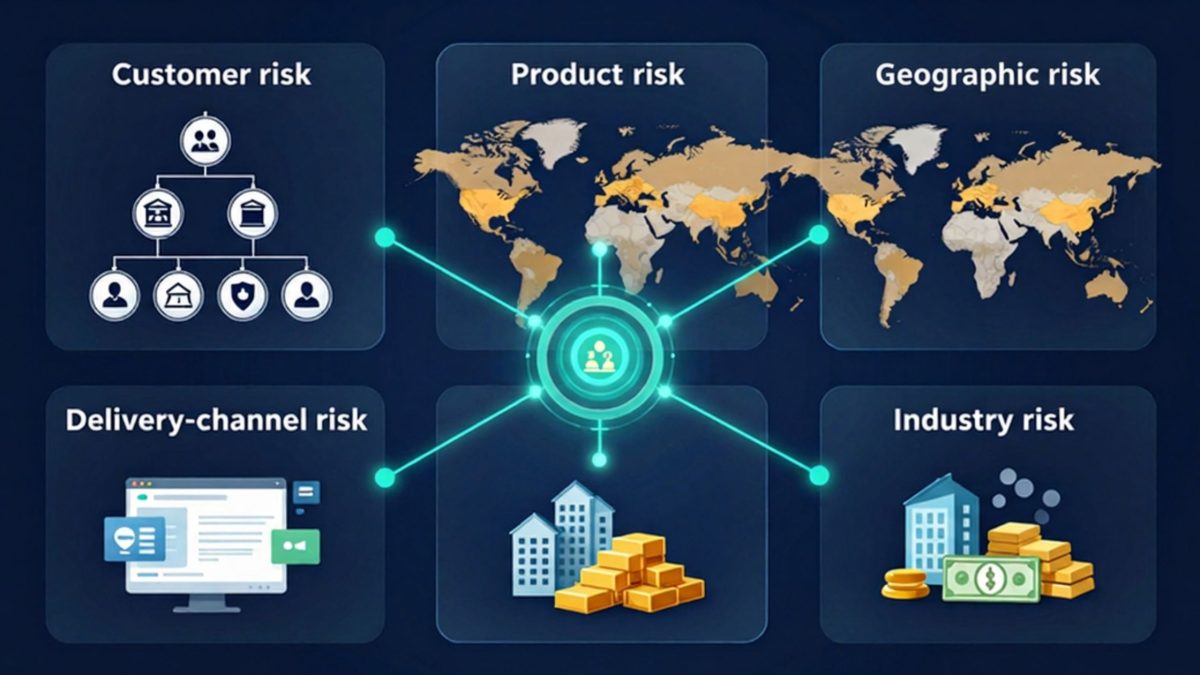
AML risk assessment is a thorough process that looks at the risk of financial crime for customers, products, services, delivery channels, and locations.
It operates at two levels:
- At the customer level, it assesses individual characteristics, e.g., ownership structure, occupation, transactional behavior, and geography.
- Enterprise-level examines exposure to products, services, delivery channels, geographies, and customer types.
Under regulatory expectations, such as the FCA’s Financial Crime Guide on Enterprise-Wide Risk Assessments, the methodology must explain:
- What risk factors are considered
- Scoring approach
- Controls mapping
- How residual risk is determined
- Assessment Review Frequency
A formal template makes sure that the whole organization is consistent, open, and easy to audit.
Key Takeaways
An effective AML risk assessment connects risk identification, measurement, mitigating controls, and residual risk to practical compliance decisions. The methodology should be documented, consistent, and regularly reviewed so institutions can apply appropriate due diligence, monitoring, governance, and resources based on their actual exposure.
- AML risk assessments evaluate money-laundering and terrorist-financing exposure across customers, products, services, delivery channels, industries, and geographies.
- A complete methodology connects four components: risk identification, risk measurement and scoring, risk mitigation controls, and residual risk determination.
- Customer-level assessments evaluate individual customer characteristics, while enterprise-wide assessments examine the institution’s overall exposure and inform decisions about resources, monitoring, staffing, and technology.
- Risk ratings should be supported by documented factors, scoring logic, control assessments, review schedules, and decision outcomes so they remain consistent and auditable.
- Risk assessment results should determine the appropriate level of customer due diligence, monitoring, documentation, escalation, and senior-management review.
- Automation can improve calculations, integration, and updates, but it does not replace documented procedures, validation, governance, or independent testing.
What are the Core Components of AML Risk Assessment Methodology?
Identification, measurement, mitigation, and residual risk evaluation are the four main parts of a complete framework.
Risk Identification
Defines the categories of exposure per the institution’s business model. These may include:
- Customer (e.g., Politically Exposed, Complex Ownership Structures, Non-Resident)
- Geography (e.g., High Risk or Sanctioned Countries)
- Product (e.g., Cross Border Wire Transfer, Trade Finance, Virtual Assets)
- Delivery (e.g., Non-Face-to-Face Onboarding, Intermediaries)
- Industry profile (e.g., Real Estate, Precious Metal Dealers, Cash-intensive sectors)
Risk assessment is based on real operational activity, not examples from regulations.
Risk Measurement and Scoring
After identifying risk factors, institutions determine how to measure them.
There are two main approaches:
- Qualitative Scoring: Risk categories (Low, Medium, High) based on expert judgment.
- Quantitative or Weighted Scoring: Numerical scoring using defined weights assigned to each risk factor.
Weights are then applied to reflect materiality. For example, geographic risk may carry more weight than delivery channel risk depending on the institution’s exposure.
Two critical concepts need to be clearly defined:
- Inherent Risk: Risk before controls are applied
- Residual Risk: Risk after accounting for control efficiency
Risk ratings become inconsistent and hard to defend during regulatory inspections if there is no documented scoring logic.
Risk Mitigation Controls
Controls are designed to reduce inherent risk to an acceptable level. These may include:
Preventive Controls
- Customer due diligence
- Screening against sanctions and PEP lists
- Risk-based rules for the onboarding of customers
Detective Controls
- Transaction monitoring
- Ongoing monitoring reviews
- Alert investigation processes
Compensating Controls
- Senior management approval
- Requirements of additional documentation
- Transaction limits
Reality checks matter when judging controls. If they seem stronger than they are, the leftover risks might appear smaller than they should.

Residual Risk Determination
The adjustment of inherent risk by the strength of the controls will provide you with your residual risk. For example, if you have high inherent risk and strong controls, you will have a medium residual risk.
Residual risk should be similar to:
- Institutional risk appetite
- Board-approved thresholds
- Escalation triggers
Customers with high residual risk may need:
- Enhanced due diligence
- Increased monitoring frequency
- Senior management approval
A solid risk assessment clearly documents the connection between scoring, controls, and decision outcomes.

What is an Enterprise-Wide AML Risk Assessment (EWRA)?
This assessment defines the institution’s overall AML exposure.
Regulators, including the Financial Action Task Force (FATF), expect institutions to carry out EWRA regularly, especially when:
- Entering new markets
- Introducing new products
- Gaining new customer segments
- Experiencing rapid business growth
Key data inputs include:
- Composition of customer base
- Product risk profiles
- Geographic exposure
- Suspicious activity trends
- Regulatory findings
The EWRA is a governance tool that informs:
- Resource allocation
- Monitoring intensity
- Staffing needs
- Technology investment
Senior management and the board are required to review the EWRA. This shows accountability and connects AML risk with enterprise risk management.

How do you Design an AML Risk Assessment Template?
An organized AML Risk Assessment Template enables the methodology to be put into practical use.
What an Effective Template Should Include
A good template usually includes:
- Risk factor categories
- Defined scoring scale
- Weight allocation
- Control mapping section
- Final risk rating
- Residual risk calculation
Templates must be legible, complete, and follow a defined methodology documentation. Templates that are too complex raise operational risk and inconsistency.
Common Mistakes in AML Risk Assessment Templates
There are several recurring deficiencies causing damage to the assessment framework:
- Complicated scoring logic
- No documented weighting reasoning
- Lack of periodic review and adjustment
- Failure to document non-standard decisions
- No audit trail
Templates are meant to be defensible. If an institution cannot explain how it determined a risk rating, the template fails its purpose.
Automation vs Manual Templates
Excel-based templates are consistently used by a lot of organizations. While they are practical, they come with risks, such as:
- Manual errors
- Version control issues
- Lack of integration with monitoring systems
System-based risk scoring has its advantages:
- Automated weight calculation
- Integration with onboarding and screening systems
- Real-time updates when risk factors change
However, automation does not remove the need for governance. Institutions still need to document procedures and carry out validation.

Linking Risk Assessment to Customer Due Diligence
A risk assessment of a customer will determine the amount or level of due diligence required for that customer.
Low-risk customers may qualify for simpler measures, while customers who are high-risk need more thorough due diligence.
Risk assessment influences:
- Documentation requirements
- Source of funds verification
- Ongoing monitoring frequency
- Review cycles
Enhanced due diligence might involve:
- Senior management approval
- Adverse media review
- Independent source verification
Operational results are impacted by the likelihood of risks occurring. If CDD intensity is not determined through a risk assessment, the overall effectiveness of the program will remain limited to just a theory.
Methodology Documentation and Governance
AML risk assessment methodology needs to be documented.
Key components of governance include:
- Written procedure documentation
- Defined roles and responsibilities
- Change management procedures
- Model validation and testing
- Periodic review schedule
Independent testing functions, which may include internal audit and quality assurance, could conduct a review to make sure that the risk assessment framework is set up and used correctly.
What are the Key Challenges in AML Risk Assessment?
Despite thorough methods, institutions often come across real challenges:
- Data Quality Issues: Weakness in the risk scoring because the customer information is not complete or correct.
- Over-Reliance on Generic Factors: Copying regulatory examples without adjusting them for the institution doesn’t function as expected and contributes to the creation of misalignment.
- Regulatory Expectation Gaps: Jurisdictions may interpret risk-based approaches differently.
- Model Bias: Some assumptions about scores may unintentionally change risk ratings.
- Changing Typologies: New risks, like virtual assets and trade-based money laundering, mean that models need to be updated all the time.
Conclusion
Regulations are not the only contributor to AML risk assessments. AML risk assessments should be changed frequently, using the results to make decisions on how to manage your risks. When done properly, it supports better decisions, stronger controls, and a more reliable compliance framework.